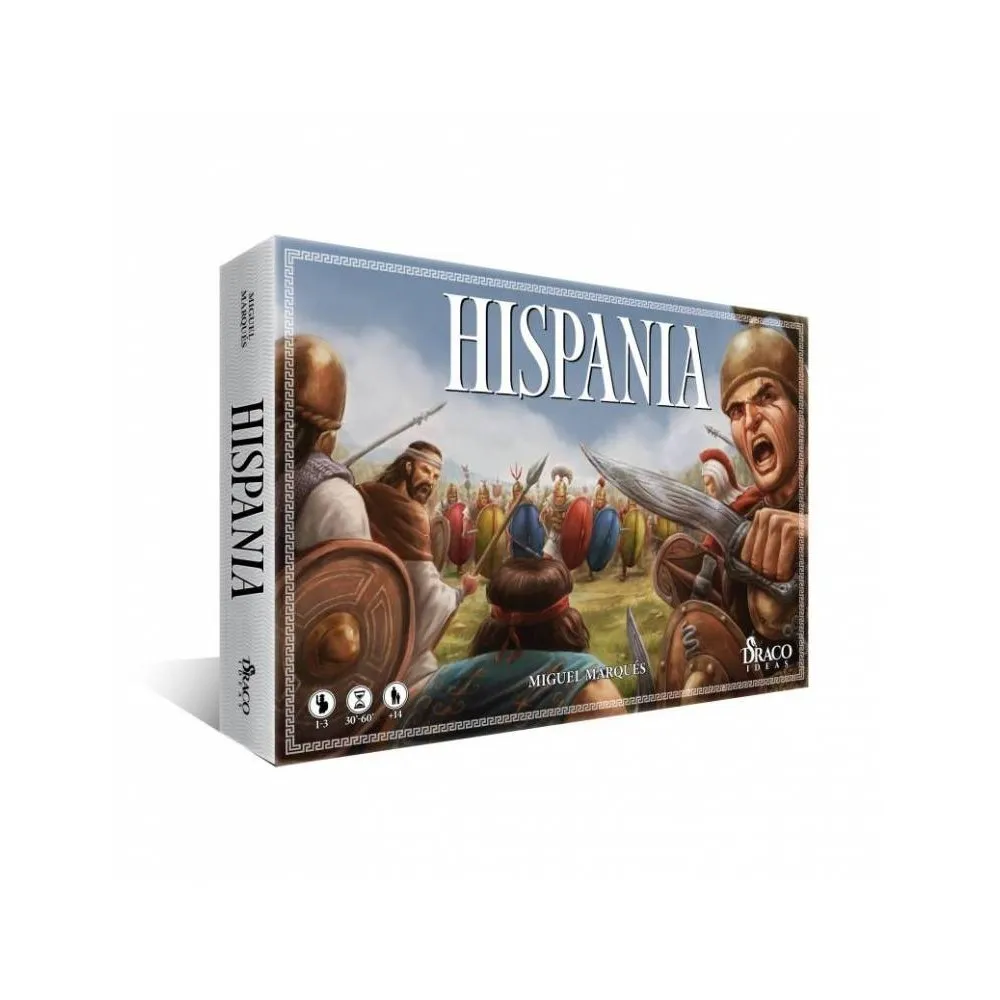
Hispania: The Roman Conquest - Second Edition
At the beginning of the 2nd century BC, the Roman Republic had just defeated its greatest nightmare, the Carthaginian Hannibal. After annexing the Carthaginian possessions on the Mediterranean coast of Hispania, it organized them into the provinces of Hispania Ulterior and Hispania Citerior and ordered its praetors to complete the conquest of the peninsula, inhabited by disparate peoples. But these Hispanians proved to be a formidable enemy...
HISPANIA is a cooperative and competitive game in which 1 to 4 players take on the roles of all the praetors and consuls that Rome had to send to Hispania over two centuries. Their objective is to subdue all the peoples of the peninsula before the turn of the millennium, thus incorporating Hispania into the burgeoning empire, emulating its first emperor, Caesar Augustus. The fate of Hispania is now in your hands!
How to play:
The objective in a game of Hispania is to gain control of all the territories by establishing garrisons in the Hispania capitals.
We'll have to do this before the revolts spread too far and we run out of revolt discs, or before we reach the final turn at the end of the millennium. In either case, we'll have lost the game.
Our turn playing Hispania: On their turn, each player receives a number of denarii, which they can use to perform the following actions:
- Attack a Hispanic army.
- Siege a city in revolt.
- Movement: To move your general or a fleet.
- Place or remove garrisons from a city.
The Hispanics' turn: Once the players have exhausted their actions, the Hispanic threat spreads across the map, the revolt intensifies, and the Hispanic armies move to try to seize new cities.
All armies attempt to move. The Carpetani army, connected to Capara and Abula (which are not in revolt), moves first. It rolls the die to decide which city to move to. Next, the Lusitanian army moves, which is connected to only one city, Conimbriga, so it moves towards it. Since there is a garrison, he lays siege to it. Finally, the Galician army is connected to four cities in its province. As all of them are in revolt, a die is rolled to decide which one to move towards.
Combat:
When our general is adjacent to an army or a city in revolt, we can engage in combat (or lay siege, in the case of the city).
To do this, we compare the Roman attack value, which is influenced by:
- The denarii used in the attack.
- The value of the garrisons connected to the general.
- The support of other generals present in the battle.
In the previous example, the Blue Consul can attack the Galician army at Bracara, spending, for example, 2 denarii, which he would add to his roll, in addition to the 2 garrisons connected to him (Noega and Asturica), and multiply by 2 due to the support of the Yellow Praetor. The Galician army would add the 3 revolts connected to it to its roll.
Our General can be defeated in battle, consuming resources and increasing the effort required to recruit new armies after the defeat.
Game components:
Box: 23x16x4 cm
Game board: A4 size (A3 size - Objective)
Rulebook
41 wooden discs
2 custom dice
8 wooden figures: 2 Roman generals, 1 proconsul and 3 Hispanic armies.
5 Roman roads
1 hourglass (turn marker)
8 Roman coins
| SKU | 698142195571 |
| Model # | DRA10001 |
| Barcode # | 698142195571 |
| Brand | Draco Ideas |
Be The First To Review This Product!
Help other Gamersphere AU PTY Limited users shop smarter by writing reviews for products you have purchased.